

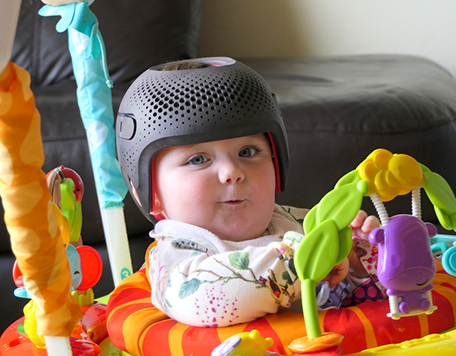
Seeing your baby wear a cranial orthosis helmet can bring up a mix of emotions. While many parents wonder if the helmet will affect their baby’s daily life, others worry about whether they have made the right decision and if it will really work. These feelings are completely normal, and most parents experience the same concerns.
The good news is that most babies get used to the helmet much faster than parents expect. When your baby receives helmet therapy under the right guidance and with timely care, it can become a natural part of their daily routine. At the same time, the therapy helps support healthy head shape development without causing discomfort.
Why Do Some Babies Need Helmet Therapy?
A baby’s skull is soft and grows rapidly during the first year of life. If a baby spends long periods resting in the same position, repeated pressure on one area of the head can lead to flattening, commonly known as plagiocephaly or flat head syndrome.
Parents of babies with an asymmetrical head often ask, Can a flat head be corrected? The answer is yes. However, the outcome depends on the baby’s age and the severity of the flattening. In mild cases, parents may notice improvement with tummy time, repositioning, and treating neck tightness. If the flattening is moderate or severe, a cranial orthosis helmet may be recommended by the doctor. These specially designed helmets gently guide skull growth and help correct flat head syndrome.
The best age for helmet therapy is usually between 4 and 12 months, when the skull is still soft and growing rapidly. During this period, it responds best to treatment.
What Is It Like for Babies to Wear a Helmet for Plagiocephaly?
Many parents are surprised by how quickly babies adjust to wearing a helmet. There is usually a short settling-in period during which babies become familiar with the helmet. After that, most babies are comfortable feeding, sleeping, playing, and reaching developmental milestones just like other infants.
A custom-made helmet is lightweight, breathable, and designed to fit your baby’s head comfortably. It does not squeeze the skull. Instead, it gently creates space for growth in flatter areas while limiting growth where it is not needed.
During the first few days, some babies may sweat a little more than usual. This usually improves as they become accustomed to wearing the helmet.
Tips to Make Helmet Therapy Easier for Your Baby
Parents play a crucial role throughout the flat head treatment journey. Their support helps babies adjust more comfortably to helmet therapy. Here are a few simple habits that can make the process smoother:
- Follow the recommended wear schedule provided by your helmet therapy specialist.
- Keep the helmet clean and dry every day.
- Check your baby’s skin during helmet-free breaks.
- Attend follow-up appointments so adjustments can be made as your baby grows.
- Continue tummy time and other exercises if recommended by your therapist.
Following the treatment plan consistently gives your baby the best opportunity to achieve the desired results.
How Our Helmet Therapy Specialists at Hope AMC Support Families
At Hope AMC, our multidisciplinary team of pediatric therapists begins with a thorough assessment before recommending cranial helmet therapy for babies. We evaluate your baby’s head shape, skull growth, neck movement, and overall development to determine the most suitable treatment plan.
If helmet therapy for plagiocephaly is recommended, we use advanced 3D scanning technology to create a custom helmet that fits comfortably and safely. Throughout the treatment journey, we closely monitor your baby’s progress through regular follow-up appointments and make adjustments whenever needed to ensure the helmet remains effective as your child grows.
Our certified and experienced helmet therapists in Dubai also guide families on daily helmet care, cleaning, repositioning techniques, and what to expect at every stage of treatment. With the right knowledge and support, parents can feel more confident and actively contribute to their child’s progress.
Wrapping Up
Every baby’s journey is different. No two babies have the same head shape or follow the same treatment timeline. Some require only monitoring, while others benefit from helmet therapy alongside physiotherapy. The most important step is having your baby assessed early, when more treatment options are available and outcomes are often better.
If you are wondering how to fix flat head concerns or have noticed changes in your baby’s head shape, we are here to help. Contact Hope AMC today to book a comprehensive assessment, and let our pediatric specialists guide you toward the most appropriate care for your child.
Frequently Asked Questions
How many hours a day does a baby wear a plagiocephaly helmet?
Most babies gradually build up to wearing the helmet for the number of hours recommended by their specialist. Your treatment plan will include a safe wearing schedule based on your baby’s individual needs.
Will my baby be uncomfortable wearing a helmet?
Most babies adapt within a few days. Because the helmet is lightweight and custom-made, it is designed to provide comfort while gently guiding natural skull growth.
How do I know if my baby needs helmet therapy?
If you notice a flat spot, uneven ears, facial asymmetry, or your baby’s head shape is not improving despite repositioning and tummy time, it is worth scheduling an assessment. Our team can determine whether monitoring, physiotherapy, or helmet therapy is the most appropriate option.
