

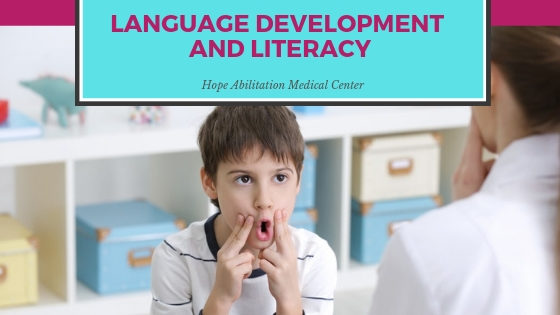
Language development and literacy play a crucial role in shaping how your child communicates, learns, and connects with others. Strong early speech and language skills support reading, writing, academic success, and social confidence. If you notice speech delays in your child, notice them hesitating when interacting with others or communicating their thoughts, consult a certified speech therapist at Hope AMC.
Importance of Language Development and Literacy in Children
Language development and literacy is no doubt a critical part of any child’s overall development. It supports the ability of your child to communicate, and express and understand feelings. It also supports your child’s thinking ability and helps them develop and maintain relationships.
Language development lays the foundation for the reading and writing skills in children as they enter and progress through school. Language is needed for all aspects of their education in the classroom as they connect with peers and teachers, and throughout their lives as they grow into adulthood. So, developing language skills is of absolute significance for every child’s progress in later life span both as social beings and in pursuing an education. Let’s dig deeper into this topic for better understanding of the facts!
Understanding the Link between Language Development and Literacy
Language development is very closely linked to literacy of a child. A plethora of research has been done on this topic and all have proven that early literacy is closely connected to language development in children during the kindergarten years.
The link between the two is quite natural because long before a child learns how to read words and recognize symbols, they develop and hone the skills required to understand how language works. Additionally, before the age of eight, children form the foundation for language and literacy development by discovering that speech has patterns and symbols have meaning. As a result, successful language development is a vital part of later achievement in reading.
However, many times, owing to different reasons language skill delays happen in children leading to inefficient vocabularies causing them to fall far behind the peers. Therefore, proper exposure to structured and age-appropriate instruction during the formative years of language and literacy development helps bridge this achievement gap.
Language and Literacy Milestones by Age
By 12 months:
- Responds to their name
- Uses simple sounds like ‘mama’ or ‘dada’
- Understands basic words like
By 18–24 months:
- Uses 20–50 words or more
- Combines two words like “more milk”
- Follows simple instructions
By 3 years:
- Speaks in short sentences
- Asks simple questions
- Is understood by familiar adults mostly
By 4–5 years:
- Tells simple stories
- Recognizes some letters and sounds
- Understands rhyming words
- Speaks clearly enough to be understood by most people
If your child is consistently missing several language skills within their age range, it may be helpful to seek professional advice.
Some of the Strategies to Support Language Development and Literacy include:
- Building Varied Vocabulary
- Increasing Phonological Awareness
- Encouraging Story Comprehension Skills
- Supporting Decoding Skills
- Leveled Literacy Intervention
Risks Associated with Delayed Language and Literacy Development
There are many negative consequences of improper language development. So, if your child is showing signs of developmental delay or if they are late talker, simply adopting a wait and see attitude could prove to be a huge mistake. As per many research studies, delayed language development have been associated with:
- Learning disabilities
- Academic difficulties
- Shyness and Social Difficulties
- Anxiety Disorder
- Behavioral Problems and ADHD
If you are concerned that your child is not keeping up with typical development with regard to language and literacy, you should always seek professional help from a pediatric neurorehabilitation professional. We at Hope AMC provide complete neurological rehabilitation assistance to such children. If you are in Dubai and need help with regard to your child’s language and literacy development, then seek help from our pediatric neurorehabilitation professionals.
When Should You Consult a Therapist?
Well, for parents, it is completely normal to have concerns about their child’s speech and learning. If you notice the following delays in your child, consult a speech-language therapist.
- Your child is not babbling by 12 months
- They are not able to use single words by 18 months
- They struggle to combine words or use multiple meaningful words by 2–3 years
- Their speech is very unclear after age 3
- They have difficulty understanding simple instructions
- They avoid eye contact while talking face-to-face
- Teachers mention concerns about language, reading, or classroom participation
How Can You Encourage Language Development and Literacy in Your Child?
The best method to encourage and boost your child’s speech and language skills is to do a lot of talking together about things that interest your child. You need to make the interaction with your child interesting, and keep responding to them so that they encouraged with the communication. When your child starts using words, you can repeat and build on what your child is saying. Talking about what’s happening in your daily day-to-day life together is a great method of increasing the number of words your child hears. You can talk about things that make sense to them, and during the conversation can use lots of different words and in different contexts. These can really help your child’s overall language development and literacy.
However, if you observe that your child is facing some extreme language development problems, then immediately consult with a professional specializing in neurorehabilitation treatments. If you are located in Dubai and are facing such problem, then you can come to us and our speech-language therapists will do their best to assist you.
Frequently Asked Questions
Early language skills are important to build the foundation for reading, writing, comprehension, and classroom learning. With strong vocabulary and communication skills from an early age, children tend to perform better academically, as they can better understand instructions, express ideas clearly, communicate with teachers and classmates, and participate confidently in class.
Yes, it can. Speech-language therapy helps children organize their thoughts, pronounce words clearly, understand language patterns, and interact more comfortably with peers in school and other environments. When communication improves, children become more socially and academically confident and show greater interest in participating in activities.
At Hope AMC, speech therapy programs are personalized based on each child’s strengths and challenges. The therapists focus on improving speech as well as supporting overall cognitive, emotional, and social development. Our well-structured sessions help children feel supported rather than pressured.
The pace of development is different for children. Some children speak well but struggle with comprehension, while others understand everything but speak less. If you notice uneven progress, it is best to visit a therapist for an assessment. A certified speech-language therapy specialist can determine whether the differences are normal and will improve as your child grows, or whether they require targeted support to meet developmental milestones.

38 Comments
Nastexo Ahmed
I can say this is really agood way
Mohammed Abdul Shakun
Crystal clear in understanding
Ruhia
Reference
Lukman Ruhia
Reference
Eliasu Moro
Thanks so much
Buena Schepis
Hi! I could have sworn I’ve been to this web site before but after browsing through a few of the articles I realized it’s new to me. Anyways, I’m definitely delighted I stumbled upon it and I’ll be bookmarking it and checking back often!
Cleveland Madeiros
I’d like to thank you for the efforts you’ve put in writing this website. I am hoping to see the same high-grade blog posts by you later on as well. In truth, your creative writing abilities has inspired me to get my own blog now 😉
Kandice Candido
This is a topic that is close to my heart… Thank you! Where are your contact details though?
Jarrett Felter
I was pretty pleased to find this great site. I wanted to thank you for ones time for this wonderful read!! I definitely really liked every bit of it and I have you saved as a favorite to see new information in your web site.
Sonia Levans
This is a topic which is near to my heart… Best wishes! Where are your contact details though?
Larelie A. Adille
How can I help my 6 years old son he is delayed in language and speech literacy.. Can you pls.help me.. Thank you so much.
slot online
Very good post.Thanks Again. Great.
Dennisjer
You made some fine points there. I did a search on the topic and found nearly all people will go along with with your blog.
Dennisjer
Hello! I just wish to give you a big thumbs up for the excellent information you have got here on this post. I’ll be returning to your website for more soon.
Boston MA Senior Home Care
I just couldn’t depart your site prior to suggesting that I really enjoyed the standard info a person provide for your visitors? Is going to be back often in order to check up on new posts
Cheap Proxies
Assisted me a lot, just what I was searching for : D.
What Is The Most Important Component Of Language Development? – Fallsgardencafe
[…] It supports the ability of your child to communicate, and express and understand feelings. It also supports your child’s thinking ability and helps them develop and maintain relationships. Language development lays the foundation for the reading and writing skills in children as they enter and progress through school. via […]
What Is The Effect Of Language And Literacy Development On Language Acquisition? – Fallsgardencafe
[…] Language development is very closely linked to literacy of a child. A plethora of research has been done on this topic and all have proven that early literacy is closely connected to language development in children during the kindergarten years. via […]
Beauty Mwendelwa
Good one
SUPERSLOT
I cannot thank you enough for the post.Much thanks again. Really Great.
Gay Nikirk
Can I simply say what a reduction to find somebody who truly is aware of what theyre speaking about on the internet. You undoubtedly know the best way to deliver a problem to gentle and make it important. More individuals have to learn this and understand this aspect of the story. I cant believe youre not more common because you undoubtedly have the gift.
mawar
It is very important to apply literacy from an early age, because there are many benefits that will be obtained. There is some other information about the same thing on the following website http://news.unair.ac.id/en/2022/03/24/low-digital-literacy-in-indonesia-it-needs-to-be-introduced-early/
Andreas Kelman
Can I simply just say what a comfort to discover a person that actually knows what they’re discussing online. You certainly understand how to bring an issue to light and make it important. More and more people have to read this and understand this side of your story. It’s surprising you’re not more popular given that you definitely have the gift.
rama
whoah this blog is wonderful i really like reading your articles. Keep up the great paintings! You realize, a lot of people are hunting round for this info, you could help them greatly.
lina
whoah this blog is wonderful i really like reading your articles. Keep up the great paintings! You realize, a lot of people are hunting round for this info, you could help them greatly.
rama
I have read so many posts about the blogger lovers however this post is really a good piece of writing, keep it up
Mpilo Mlalazi
Wow this is amzing it will help.me on my assignment on outcomes of language development for 3 to 6 years
slot demo gratis
There is definately a lot to find out about this subject. I like all the points you made
транс порно
A round of applause for your article. Much thanks again.
My website: римминг порно русское пьяные
порно жесткое
Very good post.Really looking forward to read more. Great.
My website: порно колготки порно насилие
agen2023
This was beautiful Admin. Thank you for your reflections.
Slot Demo
You’re so awesome! I don’t believe I have read a single thing like that before. So great to find someone with some original thoughts on this topic. Really.. thank you for starting this up. This website is something that is needed on the internet, someone with a little originality!
plastic mold manufacturer
I really liked your article post.Really looking forward to read more. Cool.
Bambu4d
Very well presented. Every quote was awesome and thanks for sharing the content. Keep sharing and keep motivating others.
Samurai4d
Pretty! This has been a really wonderful post. Many thanks for providing these details.
Bambu4d
Cool that really helps, thank you.
Bambu4d Login
Keep working ,terrific job!
pengeluaran taiwan
I just like the helpful information you provide in your articles