As a parent, you memorize every detail of your baby’s face, like their soft cheeks, delicate forehead, and the way their head rests on your shoulder. So when you begin to notice a flat spot or realize your baby always turns their head to one side, it can quietly stir worry.
Is this normal? Did I miss something? Will it correct itself?
You’re not alone and more importantly, you’re not too late.
Head deformities and head turn preferences are more common than most parents realize, and with early awareness and the right support, they are highly manageable.
Why Do Head Deformities Happen in Infants?
A baby’s skull is beautifully designed to be soft and flexible, allowing the brain to grow rapidly during the first year of life. However, this softness also means that constant pressure on one area can change the head shape. One of the most common conditions parents encounter is positional plagiocephaly, where a flat spot develops on one side of the head. This often happens when a baby consistently rests or turns their head in the same direction.
Head Turn Preference: A Small Habit with a Bigger Impact
A head turn preference means your baby favours looking to one side and avoids the other. Sometimes this is linked to tight neck muscles (often called torticollis), and sometimes it simply develops from early positioning.
Over time, this preference can lead to:
- Uneven pressure on the skull
- Flat spots on the head
- Facial asymmetry
- Delays in rolling, crawling, or head control
Many parents don’t notice this right awa and that’s okay. What matters is recognizing it early enough to support healthy development.
Signs Parents Should Gently Watch For:
Trust your instincts. If something feels off, it’s worth paying attention. Common signs include:
- A flat area on the back or side of your baby’s head
- Your baby is always looking in one direction
- Difficulty turning the head equally in both ways
- One ear appears more forward than the other
- Uneven forehead or cheek appearance
- Resistance or discomfort during tummy time
These signs don’t mean something is “wrong,” but they do signal that your baby may benefit from early support.
Simple Ways Parents Can Help Prevent Head Deformities:
Prevention often begins at home with small, loving adjustments.
Tummy time matters.
Frequent, supervised tummy time helps strengthen neck and shoulder muscles while relieving pressure from the skull.
Switch positions often.
Alternate feeding arms, change crib orientation, and vary how your baby lies during playtime.
Limit container time.
Extended use of car seats, swings, and bouncers can increase pressure on the same area of the head.
Encourage movement.
Use toys, sounds, and interaction to gently encourage your baby to look both ways.
These simple habits can make a meaningful difference, especially in the first few months.
When Extra Support Is Needed: Understanding Helmet Therapy
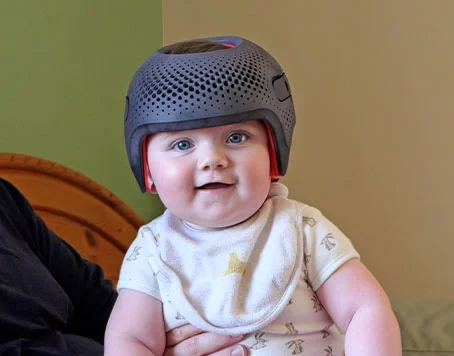
Sometimes, despite best efforts, the head shape doesn’t improve as expected. In such cases, specialists may recommend plagiocephaly helmet therapy, also known as cranial orthosis helmet therapy.
A cranial remoulding helmet is custom-made to guide natural head growth. It doesn’t press or squeeze the skull; instead, it allows growth in flatter areas while gently redirecting it from prominent ones.
Helmet therapy is most effective between 4 and 12 months, when brain growth is rapid. Parents seeking professional plagiocephaly cranial helmet treatment in Dubai often combine helmet therapy with physiotherapy for the best outcomes.
The Emotional Role of Physiotherapy in Recovery
Beyond helmets, pediatric physiotherapy plays a deeply supportive role, not just for the child, but for parents too.
Physiotherapy focuses on:
- Improving neck flexibility
- Correcting movement imbalances
- Supporting motor milestones
- Teaching parents how to help at home
At Hope AMC, experienced pediatric therapists like Ali Ramadan work closely with families, offering not just clinical expertise, but reassurance, clarity, and ongoing guidance. Parents are never left guessing, they’re supported at every step.
Why Early Care Truly Matters
Early intervention isn’t about rushing treatment, it’s about giving your baby the easiest, gentlest path forward. When addressed early:
- Treatment duration is often shorter
- Outcomes are more effective
- Long-term concerns are reduced
Most importantly, parents feel confident knowing they acted with care and awareness.
When Should You Seek a Professional Opinion?
Consider an assessment if:
- Flat spots worsen after 6-8 weeks
- Head turn preference persists
- Facial asymmetry becomes noticeable
- Your baby struggles with movement milestones
A simple evaluation can bring clarity and peace of mind.
Book Trusted Pediatric Care at Hope AMC:
If you’re worried about your baby’s head shape or movement patterns, compassionate, expert care can make all the difference. At Hope AMC, families receive personalized assessments, physiotherapy support, and access to advanced options like cranial remoulding helmet therapy in Dubai, all under one roof.
Book an appointment today and take a confident step toward your child’s healthy development.
FAQs
Yes. Helmet therapy is medically approved, lightweight, and designed to support natural brain growth safely.
Typically, between 3 to 6 months, depending on age and severity.
Yes. Mild to moderate cases often improve significantly with physiotherapy and repositioning alone.
When addressed early, most children achieve normal head shape and development without long-term issues.